
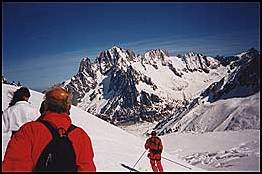
STEVEN GRAY / Special
Skiers negotiate the legendary Vallee Blanche, or White Valley, near Chamonix. |
The Atlanta Journal-Constitution: 11/03/02
Skiing in the French Alps isn't for the faint of heart
By TERRI SHAW
For the Journal-Constitution
|
|
|
|
||
It begins with a heart-stopping walk down a steep, narrow ridge and ends with a ride in a cog train down to the mountaineering town of Chamonix. In between, skiers explore some of the most spectacular mountain scenery in the world, gliding across three large glaciers surrounded by towering granite peaks.
One sunny day in April, six of us made the run, under the reassuring guidance of Giles, a sturdy mountain man who made sure that we stayed away from hidden crevasses, avalanche danger and toppling towers of ice.
As he passed out avalanche beacons and cinched us into mountaineering harnesses, he told us that "thousands" of people ski the Vallee Blanche each year. And, in fact, we saw scores of other skiers along the way, including a few children and folks who appeared to be in their 70s.
But the trip is not for casual skiers. Numerous injuries, and even deaths, occur along the route each year. No one who is not an accomplished climber should attempt it without a guide. Fortunately, many guides are available in Chamonix, all graduates of a strict French licensing program.
The level of anxiety was high when we gathered at the foot of the cable car in Chamonix, the first of two that would take us 9,000 feet almost straight up to the narrow, sharp peak towering over the town called the Aiguille du Midi, or Needle of the South. (The southern part of France is called the Midi.)
Annie, who had skied with us earlier in the week with her husband, Mike, was as nervous as I was; we had both heard about the steep walk down the ridge at the top of the run, with dropoffs of several thousand feet on each side.
As Annie and I dithered, our husbands remained outwardly calm. The fifth member of our group, a British businessman named Richard, was busy reassuring his 12-year-old son, Daniel, who would be making his first glacier run. "You'll have a great story to tell your school chums," he said.
Although we were eager to get started when we got to the top, Giles insisted that we take an elevator inside the "needle" to a viewing platform -- and with good reason. The sky was crystal clear and we could see almost the entire alpine range extending from nearby Mont Blanc, the highest mountain in Western Europe, to the Matterhorn, 36 miles away in Switzerland.
After we burned up almost a roll of film, it was time to confront the dreaded ridge that we had heard so much about. Giles strapped our skis together so we could use them as walking sticks, then roped us together.
There were two sets of fixed ropes, almost as secure as small fences, along the ridge, and the many skiers walking down had worn a path -- almost a trench -- between each set of ropes. It did not appear dangerous except for a terrifying icy spot at the top that had to be negotiated before the shorter members of the party could reach the ropes.
With many stops, starts and hesitations, we inched our way down the ridge, with Giles occasionally shouting instructions and encouragement, even running up and down beside us to make sure we were all right. The walk took our slow group more than half an hour, partly because the route was clogged with traffic -- dozens of other groups of skiers like us.
At the bottom of the ridge, we stopped at a wider spot to put on our skis, take off a few layers of clothes, reapply sun block and take in the view. A group of stronger skiers headed straight off into a steep bowl leading to the glacier, but ever-cautious Giles insisted that we follow him around to an apparently safer spot and had us sideslip down a few steep bumps, then onto another glacier.
Suddenly we were skiing on a vast expanse of snow surrounded by steep granite walls. We stopped from time to time as Giles told us the names of the surrounding mountains, which we had seen from our hotel window in Chamonix -- the Dent du Géant (giant's tooth), the Aiguille Verte (green needle). He pointed out a hikers' refuge on the side of one mountain and we could just barely see some specks he said were climbers scaling the almost vertical cliff.
Skiing down the gently sloped glacier was so exhilarating that some of us forgot about the dangers. As Giles led us toward another hiking refuge for lunch, along a long, narrow, bumpy traverse beside a field of large, gleaming blue ice towers called seracs, I suddenly lost my balance and fell. Because of a painful knee, I began to take off a ski before getting up.
"Don't! It's dangerous," Giles shouted, and lifted me bodily back on my feet. "Look up."
Above us was an overhanging clump of snow, perhaps a potential avalanche. Another potential danger Giles did not mention was explained later by another skier. Glacier ice is not always solid, and sometimes a skier will slide across a snow bridge over a chasm without realizing it. Skis distribute a skier's weight enough to get across such a bridge, but taking off a ski could cause you to break through.
After enjoying our lunch in the sunshine outside the hiking hut, we skied onto another wide glacier where dozens of groups had stopped for picnics.
Beyond was the Mer de Glace, or Sea of Ice, a riverlike glacier more than 4 miles long and almost a mile wide, that we had seen earlier from ski slopes around Chamonix. On both sides of the glacier were stony lateral moraines, formed by rocks deposited by the glacier as it receded. The moraines extended several hundred feet up the mountainside, illustrating dramatically how far the glacier had shrunk in just the past century.
The station of the Montenvers train, which would take us back to Chamonix, was built in 1908 on the edge of the glacier so tourists could ride up and view the Sea of Ice. Today, the glacier is 2,000 feet below the station.
Getting from the bottom of the glacier to the train station was the toughest part of the day. We had to take off our skis, carry them down some icy rocks, across a bridge and up 129 steps -- I counted -- to the base of a gondola that took us to the train.
The hundreds of skiers who had chosen this beautiful day to ski the Vallee Blanche crowded the gondola and the train, so there were long waits for both. We were delighted to finally get on the train and grab seats, which were oddly slanted at about a 30-degree angle to compensate for the steep incline of the tracks on the ride back to Chamonix.
Information: http://www.chamonix.com/